
Home » Articles posted by Nancy Jester (Page 4)
Author Archives: Nancy Jester
Subsidizing failure in government

So, what’s the solution to bad government? More government! DeKalb’s Interim CEO, Lee May, recently created a new full time position: Chief Integrity Officer. The word ironic comes to mind but doesn’t really do justice to the situation.
The problems demonstrated by DeKalb’s officials won’t be solved by an ethics board or an integrity officer. You know what solves ethical problems? Elected officials and government workers with ethics. DeKalb’s real and perceived problems will only be resolved with new leadership. Spending more money on faux ethics and integrity is simply just spending more of the people’s money. It doesn’t ensure or purchase ethics or good government. In fact, in addition to increasing the cost of government, it creates more opportunities for corruption. It increases cynicism. So in the style of Ben Franklin: A government that lacks ethics and public confidence to the point it creates a position to implement integrity, is likely to have neither.
The Latest and Greatest – a review on recent education articles and blogs
Like many of you, I’ve been enjoying my summer with little attention paid to the latest in the political or research world. I hope you are having a terrific summer and enjoying your family time.
Alas, I’ve spent a few days catching up with some of the most important developments as I see them. As most of you know, Mr. Jester ran, unopposed, for the DeKalb Board of Education seat from District 1. I am thrilled that Stan will be our representative on the BOE. He takes office in January. Rest assured that he has been following matters in DeKalb like a hawk.
For all things DeKalb, please make sure you are following his blog at: http://factchecker.stanjester.com/ . He posts often about developments in DeKalb. Mostly he writes about education and the DeKalb BOE but he also covers other important education and tax related subjects. So, please make sure to follow his blog. Pursuant to his blog’s title, he keeps it to “Just the facts”.
As I have been reading through the latest headlines, I’d like to point out some important, recently published blogs of note:
1) The best metro education blog, DeKalb School Watch (DSW), recently published an article on a forum/debate with the 4 remaining State School Superintendent Candidates. There are 2 remaining Republicans and Democrats that will face each other in a runoff for their party’s nomination to compete in the General Election in November. The partisan run-off is July 22nd. Click here for the link to the insightful DSW blog on this race. Apparently, Richard Woods, is the only candidate who understands and supports the local efforts in the metro area regarding local control. Kudos to Richard Woods!
2) The AJC “Get Schooled” blog posted an interesting piece on how old school drills actually result in better achievement than alternative methods. “A new study finds traditional math instruction – what many folks call “drill and kill” – is more effective in helping young children struggling in math than group work, peer tutoring or hands-on activities that use manipulations, calculators, movement and music.” Read the entire article here.
3) If you want to know and understand what is happening in Atlanta Public Schools (APS), you need to follow the Financial-Deconstruction blog. This terrific blog is written by a former CFO who now follows and documents the latest developments in APS. Recently his work was recognized by the AJC Get Schooled blog. They carried a two-part series on his analysis of the APS interim superintendent’s results. It is important reading for anyone concerned about the largest portion of the state’s budget. It is also insightful for how other metro education bureaucracies are run. Click here to read part 1 of the analysis. Click here to read part 2 of the analysis.
School Boards and The Lawyers Who Love Them
It’s always interesting when school districts bring on new/more lawyers. A very good blog that follows the Atlanta Public Schools (APS), posted this blog about the recent hiring of a new legal firm for the district.
Another APS watcher, Tom Tidwell, posted this on his Facebook page:
“Two of the biggest issues during last year’s Board of Education elections were transparency and pushing funding into the classroom. I understand that change takes time and maybe I was expecting too much from the new Board but it seems to be business as usual at APS.
Last night, the Board approved a resolution to hire Glenn Brock as outside general counsel. APS has publicly stated the desire to hire Brock was intended to reduce costs and increase efficiency so more money can be directed to the children in the schoolhouse. Nancy Morrison Meister asked Davis how theses savings and efficiencies would be realized and he clearly backed away from this notion, saying it wasn’t just a cost issue. No one could explain how this was going to be good for APS, and in fact one board member suggested they should support it simply because its what the new superintendent wants. This is concerning on a number of levels, but most importantly, at least in my mind, it is another example of APS making aspirational statements that don’t have any basis in fact or reality. Why can’t we, as parents and taxpayers, get open, honest and transparent communications from the APS and the Board?
Glenn is a good lawyer and would make a great general counsel, but if he is unwilling to take the job as a full-time, in-house position, then APS should look elsewhere. It is hard to imagine how APS intends to save money by hiring a partner at a large firm. The effective hourly rate if a GC is hired in-house at $200,000 a year would be around $100/hour. The average hourly rate for Nelson Mullins paralegals is higher than that, and the hourly rate for a partner with Glenn’s skill set is probably closer to $500 an hour.
Only two board members, Nancy Meister and Steven Davon Lee, voted against this resolution, even though there was no urgency and absolutely no reason why they could not delay this until the July meeting. Do we really want to go back to the days of Beverly Hall and the “go along to get along” board?”
What is the Georgia GOP’s Platform on Education?

There are some very specific and fixable reasons that education in Georgia is not performing better when compared to metrics from other states. Georgia still spends more on education per pupil, yet has a lower graduation than every state that borders us. Ditto when you compare us to Mississippi and Texas. We are spending more and getting less.
Georgia is missing basic financial and managerial accountability at the top levels of the state Department of Education and districts around the state. Whenever I hear someone from the education establishment in Georgia speak, I wonder why more boards, elected officials and parents aren’t having a Paul Ryan reaction. Who is responsible for the architecture of failure that has brought us to our current relative status, if not those “experts” at the top of our DOE and districts? (I exempt Dr. Avossa of Fulton and Will Schofield of Hall from my criticism at this point. Avossa is relatively new to Georgia and has been a critic of the way Georgia teaches math. Schofield seems to understand the necessity of pushing down governance to the schoolhouse level and embraces school choice. It’s worth noting that much of his experience in education came from western states.)
Where is the Republican Party on the fiasco that is public education in our state? What is our platform? K-12 education is the single largest expenditure in the state budget. Why don’t we have some way to measure, rate, disclose and hold high level officials accountable for the quality of their financial and academic management? Shouldn’t the Georgia GOP have something to say about this? Some goals? A study committee?
I’m not talking about Common Core (CC) here. CC is a ridiculous idea that will increase costs and will not drive improvements in student achievement. If Georgia’s Republican Party had a vision and strategy for education, then we could have probably avoided the CC debacle, much like Texas.
I tried to find a GA GOP statement about our party’s vision for education. I tried to find a position paper, outlining a consensus view of what Republican reforms to education would look like. I found nothing. Zip.
We don’t have to reinvent the wheel. Other states have policies and systems in place that we could adapt to work for Georgia. One example is the FIRST from Texas.
From the Texas Education Agency’s website:
The state’s school financial accountability rating system, known as the School Financial Integrity Rating System of Texas (FIRST), ensures that Texas public schools are held accountable for the quality of their financial management practices and that they improve those practices. The system is designed to encourage Texas public schools to better manage their financial resources to provide the maximum allocation possible for direct instructional purposes.
How refreshing is that!
And, of course, what good is any policy without consequences for failure? Many other states accredit their own schools and have consequences within their accreditation for poor financial and academic performance management. Tennessee is moving its lowest performing schools out of the hands of their local district and into a state run “Achievement District”. They are not alone. But, here in Georgia, our tacit policy is, “We subsidize failure.”
It is an economic certainty that if you spend more money on failure, you’ll just purchase more of it. We do so at alarming rates in Georgia and it hurts kids and taxpayers around the state. Why aren’t we rewarding those innovative districts that are doing right by kids and taxpayers with more autonomy and funding? If a district is continuing to bloat its administrative costs, why don’t we hold back on some of their state allocation? I mean, if they have so much money that they can hire excessive amounts of administrators, why should taxpayers around the state subsidize that? Isn’t that a sign that they are not economizing their budget? Would not their cutback be better spent on other endeavors, poorer districts or rebated to taxpayers?
While states around the nation have improved their financial stewardship and outcomes, we have fiddled. And the Republican Party is not engaged on this issue. While many observers glibly talk of disorganized Democrats, we should contemplate if we’re not as organized as we think. Are we winning by accident?
The Georgia GOP is focusing on minority outreach. That’s necessary and wise but what are we doing to keep those voters who are already with us? If we’re going to go down the path of identity politics, it might behoove the GOP in Georgia to recognize the obvious gender problem in the room. The majority of voters are women and the largest subset is white women.
Conveniently, education is a big issue for women voters of all colors and socioeconomic backgrounds. Just look at the 2012 vote on Amendment One. Despite the opposition of most Democrat politicians, the amendment passed in majority Democratic areas. School choice resonated with moms. The promise of school choice was as powerful for the mother of a child with learning challenges in North Fulton and the mom whose child is trapped in a failing school in South DeKalb.
The Republican Party could drastically improve the educational lives of Georgia’s children, provide better fiscal accountability, and capture the ladies’ vote, if it took affirmative steps to develop and advocate for proven, effective methods that deliver value to kids and taxpayers alike. Imagine if the Republican Party were seen by moms across the state as their ally in educating their child. Imagine if the GOP was responsible for bringing the best practices from other states to deliver results for kids. Imagine if the GOP was the taxpayers guardian; refusing to accept poor financial management. Moms of all colors across this state vote for candidates that help their children. Fiscal hawks could celebrate the sanity that this would bring to the state budget. Liberty types should be happy to see a heavy-handed, autocratic agency reform in favor of individual choices.
The Georgia GOP website says “Choose Freedom”. It’s time the Georgia GOP embraces its own tagline. There is little freedom in education in Georgia right now. Despite Amendment One, there are few school choice options for most families. The system is rigged to favor bureaucracy at every turn. Common Core is about centralization and uniformity. And remember what Milton Friedman said about that:
“The situation has changed drastically in the past half century. The number of school districts declined from 130,000 to 16,000; classroom teachers, from 96 percent of the total instructional staff to 86 percent; the fraction of school funds coming from local government, from 83 percent to 43 percent. During the same period, population nearly doubled, cost per student multiplied more than five-fold, even after allowing for inflation, and the quality of education plummeted. Schools are now run by professional bureaucrats. Monopoly and uniformity have replaced competition and diversity. Consumers of schooling have little to say. Control by producers has replaced control by consumers.” –Newsweek 1983
Parents have few choices and no real authority over how their schools function. Taxpayers are forced to contribute to a system with subpar results. Too many children leave school ill-equipped for their future. The Georgia GOP should take a stand on education that is congruent with the “Choose Freedom” motto. That’s a path to solid majority.
Georgia Education Per Pupil Spending, Graduation Rates, Tax Climate, Poverty Rating & Free/Reduced Lunch Percentage
In January, I posted this blog about education spending and results in Georgia.
In May, the US Census office released updated per pupil spending numbers. I have updated my regional map with these numbers, along with Georgia’s tax climate ranking, poverty ranking and the percentage of students receiving free/reduced lunch.
Georgia is still spending more per pupil and has a lower gradation rate than all of our border states. Texas, Tennessee and Mississippi all spend less per pupil, have higher graduation rates, better tax climate rankings and more poverty than Georgia. South Carolina and North Carolina both spend less, have higher graduation rates, similar poverty rankings but are rated below Georgia in tax climate. But look for both South and North Carolina to improve their tax climate rankings. North Carolina passed a major tax reform bill this year. South Carolina is working on a major overhaul.

Per Pupil Spending and Graduation Rates
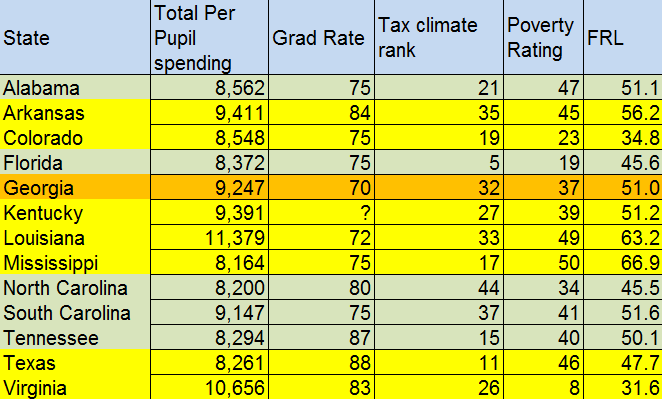
Spending, rate and ranking data
State Superintendent – Republican Primary Runoff
 The AJC had an interesting article about the Republican primary runoff for State School Superintendent. The article should be particularly interesting for school choice advocates, parents and anyone interested in government spending on education.
The two candidates, Richard Woods and Mike Buck met for a debate in Cobb County on Saturday. As the article touted, there is a clear difference between the candidates on Common Core. Woods is against Common Core and Buck is a proponent. But the most revealing comments that each candidate made were about school choice and the operations of the Georgia Department of Education.
On school choice the AJC wrote that, “Woods described the charter-school option as an intrinsic right. “We need to fight for the right of our parents to be autonomous,” he said.”
The AJC quoted Mr. Buck as saying, “I don’t have a thing in the world against charters,”… “But as the state superintendent, it is my job to make sure that public school is the choice for parents.”
Mr. Buck should know that charter schools ARE public schools. Why do the educrats within the Georgia DOE continue to see charter schools as something outside of public education? Perhaps public education is only public to them when they can control it? And, if there are no other public choices for parents, how can his statement about choice be meaningful?
The AJC article went on to say, “The debate moved to rapid-fire answers about firearms in schools, Department of Education staffing and test frequency. Woods said he would have carried a gun to protect students and teachers, would like to launch a full audit of the DOE to assess budget issues and would work to decrease the frequency of tests.
Buck preferred hiring more school resource officers over allowing more guns and described frequent testing as an accountability measure. He also said he believed the DOE is already understaffed, especially after recent budget cuts.”
One of the central principles uniting Republicans is fiscal responsibility. Republicans that will be voting in the runoff should note that one candidate, Richard Woods, stated that he would audit the Georgia DOE. The other candidate, Mike Buck, said the Georgia DOE is understaffed. That sounds like he is already planning to grow the largest bureaucracy in the state. Let’s be clear on what that means: It’s reaching into your wallet for more of your money. Georgia already spends more per pupil than all of our borders states and gets worse results. Spending more money will only continue to subsidize failure. The Georgia DOE must restructure and deliver value and results for the kids and taxpayers of our state.
I hope all the voters out there take note of this article. Richard Woods was the only candidate that espoused conservative financial principles. He is the only candidate that said parents have rights and spoke positively about charter schools as an option. I hope Republican voters are paying attention.
What is Grover Norquist Referring To?
Hey Nancy,
Local Boards of Education are required to publish tax and expenditure data. See https://ted.cviog.uga.edu/ted/Default.do . Don’t know what Grover Norquist is referring to, but it appears [you are] campaigning on something that is already there.
What’s up with that?
Del Parker
Accounting Manager at Ga Dept of Education

Grover Norquist and Americans for Tax Reform support Nancy Jester
Grover Norquist, Americans for Tax Reform, and the Cost of Government Center announced their support of Nancy Jester today in the Republican Primary for Georgia State School Superintendent.
“ATR and COGC laud the efforts of Ms. Jester to improve the education system in the state of Georgia through sensible spending, increased transparency and strong accountability” said Norquist.
Mr. Norquist is the president of Americans for Tax Reform (ATR), a taxpayer advocacy group he founded in 1985 at President Reagan’s request.
Jester said, “I am honored that Mr. Norquist, ATR, and the Cost of Government Center are supporting my campaign. I am dedicated to giving Georgians transparency and robust disclosures so they can see how their education tax dollars are being spent.”
Please help spread the word by forwarding this email to your friends and family. Ask them to join you, Grover Norquist, Erick Erickson, Sen. Josh McKoon and former Sen. Eric Johnson in voting for Nancy Jester, the proven, effective, conservative candidate for Georgia State School Superintendent.
And on election day, or when you go vote early, remember, “Nancy Jester is sixth on the ballot, first for kids and taxpayers.”


Georgia Loses Money Earmarked For Teacher Merit Pay
 With all of the talk about recent weather and traffic events, we’ve lost an important education story.
Georgia, has now become the first and only state to forfeit Race to the Top (RT3) grant money. Officials in Georgia were warned last July to address failures in implementing a new teacher evaluation system or lose almost $10 million in funding for a teacher merit pay system.
In the letter regarding the forfeiture, federal officials stated:
On September 16, 2013, I notified the State of my intent to withhold $9,904,629, pursuant to sections 454(a)(1) and 455 of the General Education Provisions Act (GEPA) (20 U.S.C. § § 1234c(a)(1) and 1234d), until the State submitted a credible plan detailing its strategy for coming into compliance with this section of its Race to the Top grant. To date, the State has not submitted such a plan. ….. To date, the OALJ has not received an application for a hearing nor have I received a written show cause response. As a result, the Department is withholding $9,904,629 of Georgia’s Race to the Top grant award, effective with this letter.
I’m not a fan of some of the aspects of RT3 but if the state commits to it, one has an obligation to manage it properly. Whether you like RT3 or not, this is an embarrassment at the national level for Georgia. The headline draws attention to the poor state of affairs regarding education management in our state. Furthermore, it removes funding that would have gone to our best performing teachers.
Georgia’s Department of Education created the very evaluation system they failed to implement. The evaluation system had problems from the start. The length of the 358-page evaluation handbook is a clue that the system may have failed under the weight of its own complexity.
Given that it is National School Choice Week, the story of a failed evaluation system is ironic. The simplicity and equilibrium of parent choice in education as a metric and driver of success is all the more compelling, compared to the byzantine and lengthy teacher evaluation system created by bureaucrats.
Georgians deserve more choice and less bureaucratic failure.
 Nancy's blog
Nancy Jester says on May 13, 2014 at 2:24 pm
I hope this offers clarity:
I am advocating for adopting a system of financial integrity indicators that are rated and disclosed via a report generated by the State DOE. I would like to see us adopt a system similar to the Financial Integrity Reporting System of Texas (FIRST). This system collects data on 20 indicators of fiscal health for each district in Texas (they have over 1000). Each indicator is scored and a composite FIRST rating is then given to the district. Districts are required to hold a public meeting to discuss and disclosure their FIRST rating. Furthermore, Texas has a list of consequences for districts with poor performance records, including poor fiscal management. We have nothing like this in the state of Georgia.
Here is what the Texas Education Agency says of the FIRST:
The purpose of the financial accountability rating system (Texas Administrative Code (TAC), Title 19, § 109.1001) is to ensure that school districts and open-enrollment charter schools are held accountable for the quality of their financial management practices and achieve improved performance in the management of their financial resources. The system is designed to encourage Texas public schools to manage their financial resources better in order to provide the maximum allocation possible for direct instructional purposes. The system will also disclose the quality of local management and decision-making processes that impact the allocation of financial resources in Texas public schools.
I also advocate for on-line check registers. Most districts in Texas now have these so that taxpayers can see timely data for each financial transaction. They can find this information easily on the district’s website. There is no need to hunt for data or only have access to old information.
The Cato Institute released a report titled “Cracking the Books” in which Georgia received an F for reporting of educational expenditures. I agree that we need to improve our financial reporting and disclosure for our educational tax dollars. School districts are not even required to hold a public review of their proposed budget. (If there is a change to the millage rate they must hold meetings about that.) This year HB 886 was introduced to require school districts to hold 2 public meetings prior to passing the budget, requires the budget be placed online, and requires that a line item budget be made available upon request at no charge.
Another missing aspect in Georgia’s stewardship of the public’s money is that we do not determine the efficacy of each dollar spent. Other states are performing studies where they are “studying the intersection of academic progress and spending for efficiencies in public education.” Georgia should be doing this as well.
The Georgia DOE website does not offer an intuitive and helpful system of data that can combine relevant and timely information on the finances of each district. Georgia’s citizens should be able to access a report that not only has financial data but also the correlating achievement and staffing data. This will allow Georgia’s citizens to see the results they are getting for the dollars they are spending.
The bottom line is that HOW we spend the taxpayers’ money will drive results. We are not even measuring this. We make getting information difficult and often provide old data. We must do better.